AKA, its not just the Americans who can be accused of bad science. The Germans are at it as well!
No, seriously. There's a German TV Channel called "Pro Sieben", (which I remember from my youth as the channel on the satellite that I'd watch Star Trek: The Next Generation on to improve my German listening skills, but anyway, I digress), who broadcast a popular science show entitled "Galileo", which is, supposedly, a show designed to introduce the general public to scientific concepts, including, for instance, why the Earth has a magnetic field. I know the origin of the Earth's magnetic field isn't an easy question to answer, but most scientists are agreed that its probably some sort of geo-dynamo effect caused by the rotation of the Earth and the Earth's molten iron core. See for example, here, or here for instance.
Not so the producers of Galileo at Pro Sieben, oh no. Geodynamo? What sort of crazy nonsense is that?! Rather, they broadcast this little gem which, as the title suggests, probably has Galileo spinning in his grave! For those who don't actually speak or read German, the interesting bit is the montage of 3 screen-shots halfway down the page, with captions that translate to:
1) This is our World.
2) At the North Pole there are enormous deposits of iron.
3) Magnets magically point here. Needles too, if they are magnetic.
I don't know whether to laugh, cry or repeatedly bang my head against my desk. Or maybe fly over to Germany and bang some heads together.
Tuesday, 12 October 2010


Wednesday, 6 October 2010
Science is indeed vital!
I've been in near-hiding the past couple of months, since I've just been plain overwhelmed with work and life. I'm coming out of my blogging exile not just for the cause of procrastination (I have a grant proposal due to our Office of Sponsored Programs on Friday, though the actual deadline is the 13th!), but to support the Science is Vital movement. I'm British. I was born in Britain, grew up in Britain, did all of my education, including my PhD, in Britain. But I've never worked as an astronomer in Britain. My first job was in France. Then I did a brief stint in India. Then I moved to the USA. And well, I'm not the only one. Funding for science in the UK is constantly being cut. Politicians think that fundamental research like the sort I'm involved in is "useless" and an economic drain. Yes, we're in an economic crisis, but I seriously don't think that cutting funding to science and engineering in a society that is increasingly meritocratic and knowledge-based is the way to rebuild confidence in the UK. And its certainly not the way to encourage people like myself to come "home" and contribute to the system that made us who we are. Why should we, when our own government doesn't value our knowledge and skills?
Wednesday, 4 August 2010
Saturday's Planetarium Show...
Just in case anyone's actually interested, here's a recording of Saturday's planetarium show. Its been somewhat edited down, but is more or less here as it was presented. So, in case anyone fancies seeing what my Scorpius and Sagittarius show was like, minus the slides, here you are, in four parts. :)
Part 1:

Part 2:

Part 3:

And Part 4:

Enjoy!
Part 1:
Part 2:
Part 3:
And Part 4:
Enjoy!
Monday, 26 July 2010
Ptolemeic and Copernican Models of the Solar System -- A Brief History
So, in my previous blog post I touched very briefly on what the ecliptic is and mentioned that the Sun and the planets move along the ecliptic. Which led me to start rambling on about the evolution of Solar System Models, from Ptolemy to Brahe and Copernicus. Which I realized was irrelevant to the post, so snipped all that discussion out and put it here instead!
So, the Sun moves along the ecliptic. As do the planets... And the stars move around a fixed point over the course of a night, and rise and set. You know nothing of gravity, but notice everything appears to revolve around us... And you therefore assume that we're the center of the solar system, because everything moves around us. Rather like Ptolemy did. This is the Ptolemeic or geo-centric model of the Solar System, where everything revolves around the Earth.
But there's a problem with it... Most of the time all of the planets chase each other around the sky moving in the same direction, but sometimes they appear to double back on themselves. So either the planets are doing their own thing, or as was suggested, and incorporated into the geo-centric model, you have the planets themselves to move on smaller ellipses (around an invisible point I guess), as they travel around the Earth -- a bit like this:

And hey, what do you know, the planets chase each other around the sky and sometimes look like they're going backwards. Woo! But that seems needlessly complicated, and besides, what are the planets going to revolve around? (That black point at the center of the epicycle is just there to show you the center!)
So then there was an idea espoused by Tycho Brahe, that the Sun orbited the Earth and all the other planets orbited the Sun. Brahe wasn't big on the Earth not being the center of the Solar System! This also worked, but well, why's the Earth so special? Just because we live here? Its all rather convenient isn't it? Looked a bit like this (from Wikipedia):

Well, I guess, if the Earth was about the same mass as the Sun then you could make that argument, but um, yeah, it doesn't really work, not if you want something consistent.
Then of course, Johannes Kepler came along, and building on what others had done (including "borrowing" some of Brahe's observations), popularized Copernicus' idea that hey, if you put the Sun at the center of the Solar System, and have all the other planets, including ourselves, revolving around the Sun, we don't need anything really complicated! And you get a Heliocentric model Of course, the Moon still orbits us, but we're no longer the center of the Solar System... What a step down. ;) And its what we now know. (Well, technically, we orbit around the center of mass, or the barycenter, or the Solar System, which is dominated by, um, the Sun, and the Sun always stays pretty close to the barycenter, but wobbles around quite a bit because of the planets). Kepler also had the pretty fantastic idea of letting the planets move around on elliptical orbits rather than circular ones (Copernicus prefered circular orbits, so the planets still needed epicycles!), and did away with the idea of epicycles. Basically getting the picture of the Solar System as we know it now. :)
So, the Sun moves along the ecliptic. As do the planets... And the stars move around a fixed point over the course of a night, and rise and set. You know nothing of gravity, but notice everything appears to revolve around us... And you therefore assume that we're the center of the solar system, because everything moves around us. Rather like Ptolemy did. This is the Ptolemeic or geo-centric model of the Solar System, where everything revolves around the Earth.
But there's a problem with it... Most of the time all of the planets chase each other around the sky moving in the same direction, but sometimes they appear to double back on themselves. So either the planets are doing their own thing, or as was suggested, and incorporated into the geo-centric model, you have the planets themselves to move on smaller ellipses (around an invisible point I guess), as they travel around the Earth -- a bit like this:

And hey, what do you know, the planets chase each other around the sky and sometimes look like they're going backwards. Woo! But that seems needlessly complicated, and besides, what are the planets going to revolve around? (That black point at the center of the epicycle is just there to show you the center!)
So then there was an idea espoused by Tycho Brahe, that the Sun orbited the Earth and all the other planets orbited the Sun. Brahe wasn't big on the Earth not being the center of the Solar System! This also worked, but well, why's the Earth so special? Just because we live here? Its all rather convenient isn't it? Looked a bit like this (from Wikipedia):
Well, I guess, if the Earth was about the same mass as the Sun then you could make that argument, but um, yeah, it doesn't really work, not if you want something consistent.
Then of course, Johannes Kepler came along, and building on what others had done (including "borrowing" some of Brahe's observations), popularized Copernicus' idea that hey, if you put the Sun at the center of the Solar System, and have all the other planets, including ourselves, revolving around the Sun, we don't need anything really complicated! And you get a Heliocentric model Of course, the Moon still orbits us, but we're no longer the center of the Solar System... What a step down. ;) And its what we now know. (Well, technically, we orbit around the center of mass, or the barycenter, or the Solar System, which is dominated by, um, the Sun, and the Sun always stays pretty close to the barycenter, but wobbles around quite a bit because of the planets). Kepler also had the pretty fantastic idea of letting the planets move around on elliptical orbits rather than circular ones (Copernicus prefered circular orbits, so the planets still needed epicycles!), and did away with the idea of epicycles. Basically getting the picture of the Solar System as we know it now. :)
Saturday, 24 July 2010
Summer Constellations
Today, I'm going to be giving a show at the Von Braun Astronomical Society Planetarium in Huntsville, Alabama on some of the summer constellations. I do a lot of work with them anyway, mainly hosting planetarium shows throughout the year, as well as doing some shows for cub scouts, school groups and other groups. So, what's the show going to be about (now that, you know, I've actually looked at it, edited it and figured out what exactly I'm going to say!)?
Well, I'm going to focus on two constellations, Scorpius and Sagittarius, both of which are summer constellations that lie on the ecliptic, which makes them part of the Zodiac. "What's the ecliptic?!" I hear the peanut gallery cry.
Its a line. In observational terms, its the line that describes the path of the Sun across the sky. Strictly speaking, its the intersection of the ecliptic plane and the celestial sphere. The celestial sphere is (obviously) the stars we can see in the sky, which looks like a large sphere from Earth. The ecliptic plane is the plane described by the Earth's orbit around the Sun. So, your ecliptic, being the intersection of a plane and a sphere, (from basic geometry) is a circle. ;)
The constellations of the Zodiac are then constellations that lie along the ecliptic, and the planets also move around the ecliptic. And if you're really interested about the planets and the ecliptic, well, that's another blog post. ;)
So Scorpius. Here he is, low and mean in the sky, if you're at high latitudes in the Northern Hemisphere.
 As you can tell, he appears in the south of the sky, having finally chased Orion out of the sky (and as mythology goes, being the one animal that could kill Orion). The brightest star in the constellation is Antares, a red supergiant, nearing the end of its life. Its name arises from its bright red color, rivaling Mars, or Ares, in its redness, hence being the star that "holds against Ares", or "Antares". The Arabic name, Qalb al-Άqrab, lends itself to the alternate name of Antares, Calbalakrab, meaning "heart of the scorpion", since, well, its at the heart of the scorpion. If we placed Antares at the location of the Sun, all of the inner planets would lie within it, with the star extending outside the orbit of Mars. We'd all be toast.
There's quite a few interesting objects in Scorpius if you want to look with a small telescope. Probably the easiest to find is M4, a globular cluster of stars, tightly bound together, all born at roughly the same time. Its just to the West of Antares, and looks pretty cool (if you look at it with Hubble ;) ):

But it also looks pretty neat through a small backyard telescope too.
So that's Scorpius. The other constellation I'm going to be talking about tonight is Sagittarius, the centaur-archer. According to Greek mythology, Sagittarius represents the centaur Chiron, son of Cronos (father of Zeus) and a mortal woman. Legend has it that Cronos disguised himself as a stallion in order to woo the woman, so that his wife, Rhea, wouldn't find out. Unlike other centaurs, who were generally wild and savage, Chiron was wise and sage, and taught many of the heroes of Greek mythology (for the Harry Potter fans, think Bane versus Firenze). However, things went a little bad, and Hercules, one of his former students, ended up wounding him. Realizing that the wound was mortal, Chiron begged his half brother, Zeus, to do something. Zeus, in order to grant him immortality, placed him in the heavens, as one of the two centaurs in the sky (Centaurus being the other, more, um, wild, one). And so, today, Chiron stands in the sky, as Sagittarius, pointing at the center of our own Galaxy, and the supermassive black hole that sits there, Sagittarius A*:
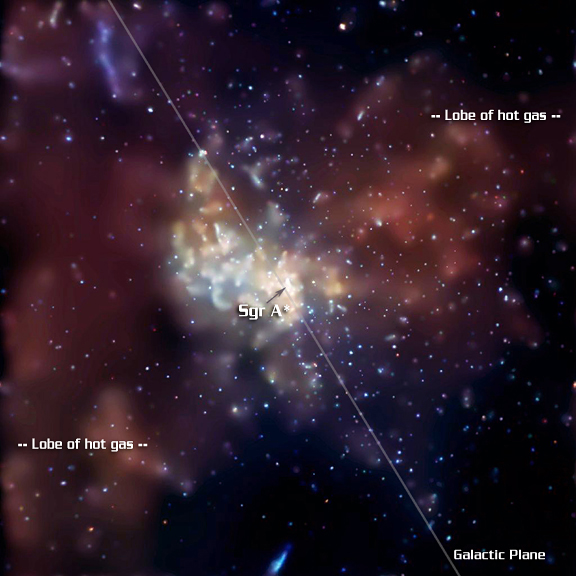
(Image from http://chandra.harvard.edu/photo/2003/0203long/more.html)
You can't actually see the black hole in this, cause well, its black, as no light can escape from a black hole, so what we do see is radiation from material that's heated up as it falls onto the black hole. The radiation's seen as X-rays, because the material's been heated up to about 10, 000, 000K (and you thought it was hotter than Hades in Alabama at the moment!). We can also look at the orbits of stars around the black hole and realize that they're orbiting something really really massive that we can't see and are being torn up, and providing the black hole with dinner (although black holes are more grazers than the three square meals a day type), as they orbit. Its actually pretty cool to look at in a variety of wavelengths, and we're learning more about black holes at the centers of galaxies every day, by studying the one in our back yard.
There's also a whole bunch of cool stuff that you can see with an optical telescope in your backyard, the coolest of which, I think, is the Trifid Nebula, located close to the tip of Sagittarius' arrow:
 Not named for the venomous, seemingly sentient plants of John Wyndham's imagination (those would be triffids!), but rather because this is actually a visual three-fer.
First of all, the blue gas at the top? Completely unrelated to everything else in that image -- its a chance superposition! Its actually called a reflection nebula, and is basically composed of cosmic dust. When starlight illuminates the nebula from behind, the photons are scattered by the dust. Because different colors of light have different energies, how much each photon is scattered depends on its color. Red photons, because they have less energy, scatter more than blue photons which sort of glance at the dust, wave at it a bit and zip on on their way (this is also why the sky is blue...). So we see the reflection nebula as blue, because all the red photons have been scattered out of our line of sight, while the blue photons make it to us. So that's the first part.
For the second and third parts, we should look at the red bits with black stripes. Enclosed in this packet of gas that's about 7600 light years away and composed of H II (That's basically a whole bunch of protons with some neutrons attached to them... Astronomers call neutral hydrogen H I, and ionized hydrogen, H II.), and has about 30 proto-stars and 120 newborn stars embedded in it (courtesy of the Spitzer Infra-Red Space Telescope). These proto and baby stars are heating the H II gas surrounding them, making it hot and causing it to give off radiation that looks, well, red. The black stripes come from clouds of dust that simply absorb the starlight, much like what we see in the Milky Way, and block the light out. So there you go, the Trifid Nebula.
There's also the Lagoon Nebula, another H II region, located slightly to the SE of the Trifid Nebula:
 And well, looks, kind of like a lagoon. On a really clear, dark night, you can even see this with your naked eye! The coolest this about this one though? Inter-stellar tornadoes. As its a star-forming region, with lots of mass, obviously, you get a lot of very massive stars being born. These stars burn very brightly, but only for a short amount of time (cosmically speaking). And because these stars burn so brightly, most of their radiation is emitted in the ultra-violet (UV). This sort of radiation has an ionizing and heating effect on gases, particularly on the surface of the nebula, where there's quite a lot of gas. So this hot, ionized gas is basically unstable, and because of the pattern that its heated in, ends up whirling around like a tornado. Tres cool. ;)
Well, I'm going to focus on two constellations, Scorpius and Sagittarius, both of which are summer constellations that lie on the ecliptic, which makes them part of the Zodiac. "What's the ecliptic?!" I hear the peanut gallery cry.
Its a line. In observational terms, its the line that describes the path of the Sun across the sky. Strictly speaking, its the intersection of the ecliptic plane and the celestial sphere. The celestial sphere is (obviously) the stars we can see in the sky, which looks like a large sphere from Earth. The ecliptic plane is the plane described by the Earth's orbit around the Sun. So, your ecliptic, being the intersection of a plane and a sphere, (from basic geometry) is a circle. ;)
The constellations of the Zodiac are then constellations that lie along the ecliptic, and the planets also move around the ecliptic. And if you're really interested about the planets and the ecliptic, well, that's another blog post. ;)
So Scorpius. Here he is, low and mean in the sky, if you're at high latitudes in the Northern Hemisphere.

There's quite a few interesting objects in Scorpius if you want to look with a small telescope. Probably the easiest to find is M4, a globular cluster of stars, tightly bound together, all born at roughly the same time. Its just to the West of Antares, and looks pretty cool (if you look at it with Hubble ;) ):
But it also looks pretty neat through a small backyard telescope too.
So that's Scorpius. The other constellation I'm going to be talking about tonight is Sagittarius, the centaur-archer. According to Greek mythology, Sagittarius represents the centaur Chiron, son of Cronos (father of Zeus) and a mortal woman. Legend has it that Cronos disguised himself as a stallion in order to woo the woman, so that his wife, Rhea, wouldn't find out. Unlike other centaurs, who were generally wild and savage, Chiron was wise and sage, and taught many of the heroes of Greek mythology (for the Harry Potter fans, think Bane versus Firenze). However, things went a little bad, and Hercules, one of his former students, ended up wounding him. Realizing that the wound was mortal, Chiron begged his half brother, Zeus, to do something. Zeus, in order to grant him immortality, placed him in the heavens, as one of the two centaurs in the sky (Centaurus being the other, more, um, wild, one). And so, today, Chiron stands in the sky, as Sagittarius, pointing at the center of our own Galaxy, and the supermassive black hole that sits there, Sagittarius A*:
(Image from http://chandra.harvard.edu/photo/2003/0203long/more.html)
You can't actually see the black hole in this, cause well, its black, as no light can escape from a black hole, so what we do see is radiation from material that's heated up as it falls onto the black hole. The radiation's seen as X-rays, because the material's been heated up to about 10, 000, 000K (and you thought it was hotter than Hades in Alabama at the moment!). We can also look at the orbits of stars around the black hole and realize that they're orbiting something really really massive that we can't see and are being torn up, and providing the black hole with dinner (although black holes are more grazers than the three square meals a day type), as they orbit. Its actually pretty cool to look at in a variety of wavelengths, and we're learning more about black holes at the centers of galaxies every day, by studying the one in our back yard.
There's also a whole bunch of cool stuff that you can see with an optical telescope in your backyard, the coolest of which, I think, is the Trifid Nebula, located close to the tip of Sagittarius' arrow:

First of all, the blue gas at the top? Completely unrelated to everything else in that image -- its a chance superposition! Its actually called a reflection nebula, and is basically composed of cosmic dust. When starlight illuminates the nebula from behind, the photons are scattered by the dust. Because different colors of light have different energies, how much each photon is scattered depends on its color. Red photons, because they have less energy, scatter more than blue photons which sort of glance at the dust, wave at it a bit and zip on on their way (this is also why the sky is blue...). So we see the reflection nebula as blue, because all the red photons have been scattered out of our line of sight, while the blue photons make it to us. So that's the first part.
For the second and third parts, we should look at the red bits with black stripes. Enclosed in this packet of gas that's about 7600 light years away and composed of H II (That's basically a whole bunch of protons with some neutrons attached to them... Astronomers call neutral hydrogen H I, and ionized hydrogen, H II.), and has about 30 proto-stars and 120 newborn stars embedded in it (courtesy of the Spitzer Infra-Red Space Telescope). These proto and baby stars are heating the H II gas surrounding them, making it hot and causing it to give off radiation that looks, well, red. The black stripes come from clouds of dust that simply absorb the starlight, much like what we see in the Milky Way, and block the light out. So there you go, the Trifid Nebula.
There's also the Lagoon Nebula, another H II region, located slightly to the SE of the Trifid Nebula:

More on Tycho Brahe's Nose
In my last post I made a passing, almost throwaway reference to Tycho Brahe's nose being made of copper, or at least a copper alloy. This led to some debate on my facebook page about whether Brahe's nose was actually made of copper alloy, or if it was, as most people believe, a precious metal (probably gold). So I did some digging, asked some friends who know more about the history of astronomy than I've forgotten and found some references!
The canonical reference for Brahe's nose being made of copper is Heinrich Matiegka's "Bericht uber die Untersuchung der Gebeine Tycho Brahe's", (Report on the Investigation of Tycho Brahe's Tomb) published in Prague, 1901. And the issue is discussed in Victor E. Thoren's "The Lord of Uraniborg: A Biography of Tycho Brahe", the rather good 1990 biography of Brahe. The basic gist is that upon exhumation of Brahe's body, it was found that he had traces of green deposit around his nose, generally indicative of oxidized copper deposits. This seems to lend credence to the theory that Brahe's nose was copper, or at least a copper and silver alloy (you need to get it pale enough to match skin tone!), rather than the usual gold or silver that is usually mentioned.
So there you have it, various references to Tycho Brahe's nose. All before breakfast! ;)
The canonical reference for Brahe's nose being made of copper is Heinrich Matiegka's "Bericht uber die Untersuchung der Gebeine Tycho Brahe's", (Report on the Investigation of Tycho Brahe's Tomb) published in Prague, 1901. And the issue is discussed in Victor E. Thoren's "The Lord of Uraniborg: A Biography of Tycho Brahe", the rather good 1990 biography of Brahe. The basic gist is that upon exhumation of Brahe's body, it was found that he had traces of green deposit around his nose, generally indicative of oxidized copper deposits. This seems to lend credence to the theory that Brahe's nose was copper, or at least a copper and silver alloy (you need to get it pale enough to match skin tone!), rather than the usual gold or silver that is usually mentioned.
So there you have it, various references to Tycho Brahe's nose. All before breakfast! ;)
Friday, 23 July 2010
Cool Word of the Day
The cool word of the day is "tungolcraft"! This is the Old English for astronomer, and translates more or less to "star craft", and "tungol" is where the modern English word "twinkle" comes from. Of course, as has been pointed out to me, "twinklecraft", whilst sounding pretty cool, would be death to the modern optical astronomer, as twinkling is a sign of atmospheric disturbance and means your seeing is going to be horrible and you're going to end up with awful images... (Hang on, isn't this why we have Hubble and Adaptive Optics etc??).
Of course, as another astronomer friend points out, being a "tungolcrafter" really needs an office adorned with lots of cool looking brass instruments, and maybe a sword by your side. Maybe you also need a copper nose and a cool sounding observatory? ;)
Of course, as another astronomer friend points out, being a "tungolcrafter" really needs an office adorned with lots of cool looking brass instruments, and maybe a sword by your side. Maybe you also need a copper nose and a cool sounding observatory? ;)
Subscribe to:
Posts (Atom)
