AKA, its not just the Americans who can be accused of bad science. The Germans are at it as well!
No, seriously. There's a German TV Channel called "Pro Sieben", (which I remember from my youth as the channel on the satellite that I'd watch Star Trek: The Next Generation on to improve my German listening skills, but anyway, I digress), who broadcast a popular science show entitled "Galileo", which is, supposedly, a show designed to introduce the general public to scientific concepts, including, for instance, why the Earth has a magnetic field. I know the origin of the Earth's magnetic field isn't an easy question to answer, but most scientists are agreed that its probably some sort of geo-dynamo effect caused by the rotation of the Earth and the Earth's molten iron core. See for example, here, or here for instance.
Not so the producers of Galileo at Pro Sieben, oh no. Geodynamo? What sort of crazy nonsense is that?! Rather, they broadcast this little gem which, as the title suggests, probably has Galileo spinning in his grave! For those who don't actually speak or read German, the interesting bit is the montage of 3 screen-shots halfway down the page, with captions that translate to:
1) This is our World.
2) At the North Pole there are enormous deposits of iron.
3) Magnets magically point here. Needles too, if they are magnetic.
I don't know whether to laugh, cry or repeatedly bang my head against my desk. Or maybe fly over to Germany and bang some heads together.
Tuesday, 12 October 2010


Wednesday, 6 October 2010
Science is indeed vital!
I've been in near-hiding the past couple of months, since I've just been plain overwhelmed with work and life. I'm coming out of my blogging exile not just for the cause of procrastination (I have a grant proposal due to our Office of Sponsored Programs on Friday, though the actual deadline is the 13th!), but to support the Science is Vital movement. I'm British. I was born in Britain, grew up in Britain, did all of my education, including my PhD, in Britain. But I've never worked as an astronomer in Britain. My first job was in France. Then I did a brief stint in India. Then I moved to the USA. And well, I'm not the only one. Funding for science in the UK is constantly being cut. Politicians think that fundamental research like the sort I'm involved in is "useless" and an economic drain. Yes, we're in an economic crisis, but I seriously don't think that cutting funding to science and engineering in a society that is increasingly meritocratic and knowledge-based is the way to rebuild confidence in the UK. And its certainly not the way to encourage people like myself to come "home" and contribute to the system that made us who we are. Why should we, when our own government doesn't value our knowledge and skills?
Wednesday, 4 August 2010
Saturday's Planetarium Show...
Just in case anyone's actually interested, here's a recording of Saturday's planetarium show. Its been somewhat edited down, but is more or less here as it was presented. So, in case anyone fancies seeing what my Scorpius and Sagittarius show was like, minus the slides, here you are, in four parts. :)
Part 1:

Part 2:

Part 3:

And Part 4:

Enjoy!
Part 1:
Part 2:
Part 3:
And Part 4:
Enjoy!
Monday, 26 July 2010
Ptolemeic and Copernican Models of the Solar System -- A Brief History
So, in my previous blog post I touched very briefly on what the ecliptic is and mentioned that the Sun and the planets move along the ecliptic. Which led me to start rambling on about the evolution of Solar System Models, from Ptolemy to Brahe and Copernicus. Which I realized was irrelevant to the post, so snipped all that discussion out and put it here instead!
So, the Sun moves along the ecliptic. As do the planets... And the stars move around a fixed point over the course of a night, and rise and set. You know nothing of gravity, but notice everything appears to revolve around us... And you therefore assume that we're the center of the solar system, because everything moves around us. Rather like Ptolemy did. This is the Ptolemeic or geo-centric model of the Solar System, where everything revolves around the Earth.
But there's a problem with it... Most of the time all of the planets chase each other around the sky moving in the same direction, but sometimes they appear to double back on themselves. So either the planets are doing their own thing, or as was suggested, and incorporated into the geo-centric model, you have the planets themselves to move on smaller ellipses (around an invisible point I guess), as they travel around the Earth -- a bit like this:

And hey, what do you know, the planets chase each other around the sky and sometimes look like they're going backwards. Woo! But that seems needlessly complicated, and besides, what are the planets going to revolve around? (That black point at the center of the epicycle is just there to show you the center!)
So then there was an idea espoused by Tycho Brahe, that the Sun orbited the Earth and all the other planets orbited the Sun. Brahe wasn't big on the Earth not being the center of the Solar System! This also worked, but well, why's the Earth so special? Just because we live here? Its all rather convenient isn't it? Looked a bit like this (from Wikipedia):

Well, I guess, if the Earth was about the same mass as the Sun then you could make that argument, but um, yeah, it doesn't really work, not if you want something consistent.
Then of course, Johannes Kepler came along, and building on what others had done (including "borrowing" some of Brahe's observations), popularized Copernicus' idea that hey, if you put the Sun at the center of the Solar System, and have all the other planets, including ourselves, revolving around the Sun, we don't need anything really complicated! And you get a Heliocentric model Of course, the Moon still orbits us, but we're no longer the center of the Solar System... What a step down. ;) And its what we now know. (Well, technically, we orbit around the center of mass, or the barycenter, or the Solar System, which is dominated by, um, the Sun, and the Sun always stays pretty close to the barycenter, but wobbles around quite a bit because of the planets). Kepler also had the pretty fantastic idea of letting the planets move around on elliptical orbits rather than circular ones (Copernicus prefered circular orbits, so the planets still needed epicycles!), and did away with the idea of epicycles. Basically getting the picture of the Solar System as we know it now. :)
So, the Sun moves along the ecliptic. As do the planets... And the stars move around a fixed point over the course of a night, and rise and set. You know nothing of gravity, but notice everything appears to revolve around us... And you therefore assume that we're the center of the solar system, because everything moves around us. Rather like Ptolemy did. This is the Ptolemeic or geo-centric model of the Solar System, where everything revolves around the Earth.
But there's a problem with it... Most of the time all of the planets chase each other around the sky moving in the same direction, but sometimes they appear to double back on themselves. So either the planets are doing their own thing, or as was suggested, and incorporated into the geo-centric model, you have the planets themselves to move on smaller ellipses (around an invisible point I guess), as they travel around the Earth -- a bit like this:

And hey, what do you know, the planets chase each other around the sky and sometimes look like they're going backwards. Woo! But that seems needlessly complicated, and besides, what are the planets going to revolve around? (That black point at the center of the epicycle is just there to show you the center!)
So then there was an idea espoused by Tycho Brahe, that the Sun orbited the Earth and all the other planets orbited the Sun. Brahe wasn't big on the Earth not being the center of the Solar System! This also worked, but well, why's the Earth so special? Just because we live here? Its all rather convenient isn't it? Looked a bit like this (from Wikipedia):
Well, I guess, if the Earth was about the same mass as the Sun then you could make that argument, but um, yeah, it doesn't really work, not if you want something consistent.
Then of course, Johannes Kepler came along, and building on what others had done (including "borrowing" some of Brahe's observations), popularized Copernicus' idea that hey, if you put the Sun at the center of the Solar System, and have all the other planets, including ourselves, revolving around the Sun, we don't need anything really complicated! And you get a Heliocentric model Of course, the Moon still orbits us, but we're no longer the center of the Solar System... What a step down. ;) And its what we now know. (Well, technically, we orbit around the center of mass, or the barycenter, or the Solar System, which is dominated by, um, the Sun, and the Sun always stays pretty close to the barycenter, but wobbles around quite a bit because of the planets). Kepler also had the pretty fantastic idea of letting the planets move around on elliptical orbits rather than circular ones (Copernicus prefered circular orbits, so the planets still needed epicycles!), and did away with the idea of epicycles. Basically getting the picture of the Solar System as we know it now. :)
Saturday, 24 July 2010
Summer Constellations
Today, I'm going to be giving a show at the Von Braun Astronomical Society Planetarium in Huntsville, Alabama on some of the summer constellations. I do a lot of work with them anyway, mainly hosting planetarium shows throughout the year, as well as doing some shows for cub scouts, school groups and other groups. So, what's the show going to be about (now that, you know, I've actually looked at it, edited it and figured out what exactly I'm going to say!)?
Well, I'm going to focus on two constellations, Scorpius and Sagittarius, both of which are summer constellations that lie on the ecliptic, which makes them part of the Zodiac. "What's the ecliptic?!" I hear the peanut gallery cry.
Its a line. In observational terms, its the line that describes the path of the Sun across the sky. Strictly speaking, its the intersection of the ecliptic plane and the celestial sphere. The celestial sphere is (obviously) the stars we can see in the sky, which looks like a large sphere from Earth. The ecliptic plane is the plane described by the Earth's orbit around the Sun. So, your ecliptic, being the intersection of a plane and a sphere, (from basic geometry) is a circle. ;)
The constellations of the Zodiac are then constellations that lie along the ecliptic, and the planets also move around the ecliptic. And if you're really interested about the planets and the ecliptic, well, that's another blog post. ;)
So Scorpius. Here he is, low and mean in the sky, if you're at high latitudes in the Northern Hemisphere.
 As you can tell, he appears in the south of the sky, having finally chased Orion out of the sky (and as mythology goes, being the one animal that could kill Orion). The brightest star in the constellation is Antares, a red supergiant, nearing the end of its life. Its name arises from its bright red color, rivaling Mars, or Ares, in its redness, hence being the star that "holds against Ares", or "Antares". The Arabic name, Qalb al-Άqrab, lends itself to the alternate name of Antares, Calbalakrab, meaning "heart of the scorpion", since, well, its at the heart of the scorpion. If we placed Antares at the location of the Sun, all of the inner planets would lie within it, with the star extending outside the orbit of Mars. We'd all be toast.
There's quite a few interesting objects in Scorpius if you want to look with a small telescope. Probably the easiest to find is M4, a globular cluster of stars, tightly bound together, all born at roughly the same time. Its just to the West of Antares, and looks pretty cool (if you look at it with Hubble ;) ):

But it also looks pretty neat through a small backyard telescope too.
So that's Scorpius. The other constellation I'm going to be talking about tonight is Sagittarius, the centaur-archer. According to Greek mythology, Sagittarius represents the centaur Chiron, son of Cronos (father of Zeus) and a mortal woman. Legend has it that Cronos disguised himself as a stallion in order to woo the woman, so that his wife, Rhea, wouldn't find out. Unlike other centaurs, who were generally wild and savage, Chiron was wise and sage, and taught many of the heroes of Greek mythology (for the Harry Potter fans, think Bane versus Firenze). However, things went a little bad, and Hercules, one of his former students, ended up wounding him. Realizing that the wound was mortal, Chiron begged his half brother, Zeus, to do something. Zeus, in order to grant him immortality, placed him in the heavens, as one of the two centaurs in the sky (Centaurus being the other, more, um, wild, one). And so, today, Chiron stands in the sky, as Sagittarius, pointing at the center of our own Galaxy, and the supermassive black hole that sits there, Sagittarius A*:
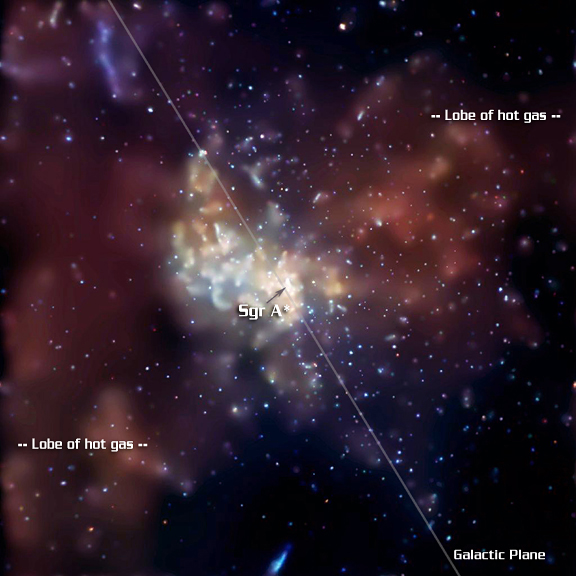
(Image from http://chandra.harvard.edu/photo/2003/0203long/more.html)
You can't actually see the black hole in this, cause well, its black, as no light can escape from a black hole, so what we do see is radiation from material that's heated up as it falls onto the black hole. The radiation's seen as X-rays, because the material's been heated up to about 10, 000, 000K (and you thought it was hotter than Hades in Alabama at the moment!). We can also look at the orbits of stars around the black hole and realize that they're orbiting something really really massive that we can't see and are being torn up, and providing the black hole with dinner (although black holes are more grazers than the three square meals a day type), as they orbit. Its actually pretty cool to look at in a variety of wavelengths, and we're learning more about black holes at the centers of galaxies every day, by studying the one in our back yard.
There's also a whole bunch of cool stuff that you can see with an optical telescope in your backyard, the coolest of which, I think, is the Trifid Nebula, located close to the tip of Sagittarius' arrow:
 Not named for the venomous, seemingly sentient plants of John Wyndham's imagination (those would be triffids!), but rather because this is actually a visual three-fer.
First of all, the blue gas at the top? Completely unrelated to everything else in that image -- its a chance superposition! Its actually called a reflection nebula, and is basically composed of cosmic dust. When starlight illuminates the nebula from behind, the photons are scattered by the dust. Because different colors of light have different energies, how much each photon is scattered depends on its color. Red photons, because they have less energy, scatter more than blue photons which sort of glance at the dust, wave at it a bit and zip on on their way (this is also why the sky is blue...). So we see the reflection nebula as blue, because all the red photons have been scattered out of our line of sight, while the blue photons make it to us. So that's the first part.
For the second and third parts, we should look at the red bits with black stripes. Enclosed in this packet of gas that's about 7600 light years away and composed of H II (That's basically a whole bunch of protons with some neutrons attached to them... Astronomers call neutral hydrogen H I, and ionized hydrogen, H II.), and has about 30 proto-stars and 120 newborn stars embedded in it (courtesy of the Spitzer Infra-Red Space Telescope). These proto and baby stars are heating the H II gas surrounding them, making it hot and causing it to give off radiation that looks, well, red. The black stripes come from clouds of dust that simply absorb the starlight, much like what we see in the Milky Way, and block the light out. So there you go, the Trifid Nebula.
There's also the Lagoon Nebula, another H II region, located slightly to the SE of the Trifid Nebula:
 And well, looks, kind of like a lagoon. On a really clear, dark night, you can even see this with your naked eye! The coolest this about this one though? Inter-stellar tornadoes. As its a star-forming region, with lots of mass, obviously, you get a lot of very massive stars being born. These stars burn very brightly, but only for a short amount of time (cosmically speaking). And because these stars burn so brightly, most of their radiation is emitted in the ultra-violet (UV). This sort of radiation has an ionizing and heating effect on gases, particularly on the surface of the nebula, where there's quite a lot of gas. So this hot, ionized gas is basically unstable, and because of the pattern that its heated in, ends up whirling around like a tornado. Tres cool. ;)
Well, I'm going to focus on two constellations, Scorpius and Sagittarius, both of which are summer constellations that lie on the ecliptic, which makes them part of the Zodiac. "What's the ecliptic?!" I hear the peanut gallery cry.
Its a line. In observational terms, its the line that describes the path of the Sun across the sky. Strictly speaking, its the intersection of the ecliptic plane and the celestial sphere. The celestial sphere is (obviously) the stars we can see in the sky, which looks like a large sphere from Earth. The ecliptic plane is the plane described by the Earth's orbit around the Sun. So, your ecliptic, being the intersection of a plane and a sphere, (from basic geometry) is a circle. ;)
The constellations of the Zodiac are then constellations that lie along the ecliptic, and the planets also move around the ecliptic. And if you're really interested about the planets and the ecliptic, well, that's another blog post. ;)
So Scorpius. Here he is, low and mean in the sky, if you're at high latitudes in the Northern Hemisphere.

There's quite a few interesting objects in Scorpius if you want to look with a small telescope. Probably the easiest to find is M4, a globular cluster of stars, tightly bound together, all born at roughly the same time. Its just to the West of Antares, and looks pretty cool (if you look at it with Hubble ;) ):
But it also looks pretty neat through a small backyard telescope too.
So that's Scorpius. The other constellation I'm going to be talking about tonight is Sagittarius, the centaur-archer. According to Greek mythology, Sagittarius represents the centaur Chiron, son of Cronos (father of Zeus) and a mortal woman. Legend has it that Cronos disguised himself as a stallion in order to woo the woman, so that his wife, Rhea, wouldn't find out. Unlike other centaurs, who were generally wild and savage, Chiron was wise and sage, and taught many of the heroes of Greek mythology (for the Harry Potter fans, think Bane versus Firenze). However, things went a little bad, and Hercules, one of his former students, ended up wounding him. Realizing that the wound was mortal, Chiron begged his half brother, Zeus, to do something. Zeus, in order to grant him immortality, placed him in the heavens, as one of the two centaurs in the sky (Centaurus being the other, more, um, wild, one). And so, today, Chiron stands in the sky, as Sagittarius, pointing at the center of our own Galaxy, and the supermassive black hole that sits there, Sagittarius A*:
(Image from http://chandra.harvard.edu/photo/2003/0203long/more.html)
You can't actually see the black hole in this, cause well, its black, as no light can escape from a black hole, so what we do see is radiation from material that's heated up as it falls onto the black hole. The radiation's seen as X-rays, because the material's been heated up to about 10, 000, 000K (and you thought it was hotter than Hades in Alabama at the moment!). We can also look at the orbits of stars around the black hole and realize that they're orbiting something really really massive that we can't see and are being torn up, and providing the black hole with dinner (although black holes are more grazers than the three square meals a day type), as they orbit. Its actually pretty cool to look at in a variety of wavelengths, and we're learning more about black holes at the centers of galaxies every day, by studying the one in our back yard.
There's also a whole bunch of cool stuff that you can see with an optical telescope in your backyard, the coolest of which, I think, is the Trifid Nebula, located close to the tip of Sagittarius' arrow:

First of all, the blue gas at the top? Completely unrelated to everything else in that image -- its a chance superposition! Its actually called a reflection nebula, and is basically composed of cosmic dust. When starlight illuminates the nebula from behind, the photons are scattered by the dust. Because different colors of light have different energies, how much each photon is scattered depends on its color. Red photons, because they have less energy, scatter more than blue photons which sort of glance at the dust, wave at it a bit and zip on on their way (this is also why the sky is blue...). So we see the reflection nebula as blue, because all the red photons have been scattered out of our line of sight, while the blue photons make it to us. So that's the first part.
For the second and third parts, we should look at the red bits with black stripes. Enclosed in this packet of gas that's about 7600 light years away and composed of H II (That's basically a whole bunch of protons with some neutrons attached to them... Astronomers call neutral hydrogen H I, and ionized hydrogen, H II.), and has about 30 proto-stars and 120 newborn stars embedded in it (courtesy of the Spitzer Infra-Red Space Telescope). These proto and baby stars are heating the H II gas surrounding them, making it hot and causing it to give off radiation that looks, well, red. The black stripes come from clouds of dust that simply absorb the starlight, much like what we see in the Milky Way, and block the light out. So there you go, the Trifid Nebula.
There's also the Lagoon Nebula, another H II region, located slightly to the SE of the Trifid Nebula:

More on Tycho Brahe's Nose
In my last post I made a passing, almost throwaway reference to Tycho Brahe's nose being made of copper, or at least a copper alloy. This led to some debate on my facebook page about whether Brahe's nose was actually made of copper alloy, or if it was, as most people believe, a precious metal (probably gold). So I did some digging, asked some friends who know more about the history of astronomy than I've forgotten and found some references!
The canonical reference for Brahe's nose being made of copper is Heinrich Matiegka's "Bericht uber die Untersuchung der Gebeine Tycho Brahe's", (Report on the Investigation of Tycho Brahe's Tomb) published in Prague, 1901. And the issue is discussed in Victor E. Thoren's "The Lord of Uraniborg: A Biography of Tycho Brahe", the rather good 1990 biography of Brahe. The basic gist is that upon exhumation of Brahe's body, it was found that he had traces of green deposit around his nose, generally indicative of oxidized copper deposits. This seems to lend credence to the theory that Brahe's nose was copper, or at least a copper and silver alloy (you need to get it pale enough to match skin tone!), rather than the usual gold or silver that is usually mentioned.
So there you have it, various references to Tycho Brahe's nose. All before breakfast! ;)
The canonical reference for Brahe's nose being made of copper is Heinrich Matiegka's "Bericht uber die Untersuchung der Gebeine Tycho Brahe's", (Report on the Investigation of Tycho Brahe's Tomb) published in Prague, 1901. And the issue is discussed in Victor E. Thoren's "The Lord of Uraniborg: A Biography of Tycho Brahe", the rather good 1990 biography of Brahe. The basic gist is that upon exhumation of Brahe's body, it was found that he had traces of green deposit around his nose, generally indicative of oxidized copper deposits. This seems to lend credence to the theory that Brahe's nose was copper, or at least a copper and silver alloy (you need to get it pale enough to match skin tone!), rather than the usual gold or silver that is usually mentioned.
So there you have it, various references to Tycho Brahe's nose. All before breakfast! ;)
Friday, 23 July 2010
Cool Word of the Day
The cool word of the day is "tungolcraft"! This is the Old English for astronomer, and translates more or less to "star craft", and "tungol" is where the modern English word "twinkle" comes from. Of course, as has been pointed out to me, "twinklecraft", whilst sounding pretty cool, would be death to the modern optical astronomer, as twinkling is a sign of atmospheric disturbance and means your seeing is going to be horrible and you're going to end up with awful images... (Hang on, isn't this why we have Hubble and Adaptive Optics etc??).
Of course, as another astronomer friend points out, being a "tungolcrafter" really needs an office adorned with lots of cool looking brass instruments, and maybe a sword by your side. Maybe you also need a copper nose and a cool sounding observatory? ;)
Of course, as another astronomer friend points out, being a "tungolcrafter" really needs an office adorned with lots of cool looking brass instruments, and maybe a sword by your side. Maybe you also need a copper nose and a cool sounding observatory? ;)
Tuesday, 29 June 2010
Why is a galaxy cluster like an uncooked cake?
OK, so I've been a bit lax on this blog, but as promised, more updates! (I've been busy with work and dancing, what can I say!). So, why is a galaxy cluster (a what?!) like an uncooked cake.
Well, let's start with a brief introduction of what a galaxy cluster actually is. (Cliche alert!) A galaxy cluster is basically one of the largest gravitationally bound structures in the Universe. About 3,000,000 light years from side to side -- that is to say it takes light 3,000,000 years to get from one side to another (it takes 8 minutes for light to travel from the Sun to the Earth, and 100,000 years for light to travel from one side of the Milky Way to the other), and made up of dark matter, galaxies and gas that's so hot (we're talking 10,000,000 degrees Celsius sort of hot!), that it emits X-rays rather than say visible light. So that's what a galaxy cluster is. Why is it like an uncooked cake (with raisins in it) then?
OK, well, its like this:
Dark matter = Cake tin
Galaxies = Raisins
Hot X-ray Gas = Batter
Your cake tin determines the shape of your cake, right? When you bake your cake, you don't end up with bits of cake tin in your cake -- the tin and the cake don't really interact with each other. You drop your cake, your cake tin retains its shape (more or less). Dark matter in a galaxy cluster is like that. It determines the shape/size of the cluster, it doesn't interact with the galaxies or the hot gas, and after a collision, it keeps its shape, rather like what we see in the Bullet Cluster (we're imaginative with names ;) )
Your raisins just kind of sit there suspended in your cake batter, right? If you apply enough force to them, the raisins will move, but otherwise, they'll basically sit there. Galaxies are the same. Yeah, they move, because they have gravity (from the dark matter) acting on them, but its not really significant.
Now for your cake batter. It flows to conform to the shape of your cake tin, holds your raisins, if your raisins move, it shows the tracks of how the raisins moved, and if you drop your uncooked cake, your batter will fly everywhere. The hot gas is basically the same. It takes on the shape (if undisturbed) provided by the dark matter, traces the motion of the galaxies, traces anything the galaxies do, and if your cluster bumps into another one, the hot gas goes flying everywhere (see the Bullet Cluster above).
And that, ladies and gents, is why a galaxy cluster is like an uncooked cake. :)
Well, let's start with a brief introduction of what a galaxy cluster actually is. (Cliche alert!) A galaxy cluster is basically one of the largest gravitationally bound structures in the Universe. About 3,000,000 light years from side to side -- that is to say it takes light 3,000,000 years to get from one side to another (it takes 8 minutes for light to travel from the Sun to the Earth, and 100,000 years for light to travel from one side of the Milky Way to the other), and made up of dark matter, galaxies and gas that's so hot (we're talking 10,000,000 degrees Celsius sort of hot!), that it emits X-rays rather than say visible light. So that's what a galaxy cluster is. Why is it like an uncooked cake (with raisins in it) then?
OK, well, its like this:
Dark matter = Cake tin
Galaxies = Raisins
Hot X-ray Gas = Batter
Your cake tin determines the shape of your cake, right? When you bake your cake, you don't end up with bits of cake tin in your cake -- the tin and the cake don't really interact with each other. You drop your cake, your cake tin retains its shape (more or less). Dark matter in a galaxy cluster is like that. It determines the shape/size of the cluster, it doesn't interact with the galaxies or the hot gas, and after a collision, it keeps its shape, rather like what we see in the Bullet Cluster (we're imaginative with names ;) )
Your raisins just kind of sit there suspended in your cake batter, right? If you apply enough force to them, the raisins will move, but otherwise, they'll basically sit there. Galaxies are the same. Yeah, they move, because they have gravity (from the dark matter) acting on them, but its not really significant.
Now for your cake batter. It flows to conform to the shape of your cake tin, holds your raisins, if your raisins move, it shows the tracks of how the raisins moved, and if you drop your uncooked cake, your batter will fly everywhere. The hot gas is basically the same. It takes on the shape (if undisturbed) provided by the dark matter, traces the motion of the galaxies, traces anything the galaxies do, and if your cluster bumps into another one, the hot gas goes flying everywhere (see the Bullet Cluster above).
And that, ladies and gents, is why a galaxy cluster is like an uncooked cake. :)
Thursday, 25 March 2010
Not all carbohydrates are created equal
This is actually going to be a non-astrophysics post. But it is going to be about science, if a little more personal than normal, and in fact, biology related.
First things first, I'm diabetic. Have been for about 13 years now, and for a lot of that time, have had pretty good control over my sugar levels. The times I haven't have been because meds have stopped working, or due to circumstances beyond my control I've had to eat things that do not work well with my body chemistry. Even when controlled, certain foods (rice, wheat bread, etc) will cause my blood sugars to spike up like a spiky thing. So I've learnt, with the aid of recipe books, with the aid of websites like The Glycemic Index what works, what releases carbohydrate slowly into my blood stream, what causes spiky spikes, what I can and cannot eat and how to balance my meals in order to maintain best control. In other words, I treat my diabetes like a science experiment. I figure out what works, read the research to find the "best practice", then put it into motion to help me keep control of this thing. Also, I've learnt that fewer calories + exercise -> body going into starvation mode -> no weight loss.
So imagine my surprise today at the diabetes management class my endo required me to attend. The nutritionist gave the normal advice of "eat less, exercise more", which is true to an extent, but not always. And then we moved onto label reading and carbohydrate counting. Somewhat naïvely, I now realise, I expected a long lecture re complex versus simple carbohydrates, the "carbohydrate" versus "sugars" lines on food labels, and advice that you probably wanted "sugars - dietary fiber" to be less than ~10% of the total carbohydrate load. Basically, foods full of complex carbs, that would be digested slowly, releasing a steady stream of glucose into the bloodstream, that would keep one fuller for longer. I also expected more about glycemic loads and how to put into practice the fact that some foods release carbs faster than others, and are, in many ways, more lethal for one's control than just chugging pure glucose. (There's also the role of acids in slowing glucose uptake, but I figure now, that that's really advanced stuff.)
How wrong was I. Her basic advice was "eat a lot less, count your carbs, but don't actually pay attention to where those carbs are coming from." Oh, she conceded that stuff without added sugar was better, but really, if it didn't have added sugar, it didn't really matter if your 15g of carbs came primarily from sugars or from other sources. I almost headdesked. Repeatedly. I asked about glycemic loads and indices, and was told that "well, its not FDA approved so we can't say that it works." Because research from the rest of the western world doesn't count, obviously. My comments of "these are the regimens that doctors in France and England had me on, and it worked" was met with "well, it could have been the meds". The fact that since I went back onto a low GI diet, I saw immediate improvement didn't sway her. She blithely insisted that it was only the total number of carbs that mattered in a meal, not the source of said carbs. Really lady, because a diabetic having a brownie for lunch and a diabetic having a green leafy salad, with grilled chicken, croutons and some form of multi-grain bread are going to have identical blood sugars 2 hours after lunch.
I can understand being nervous for a totally unproven therapy, but is approved in most near rest of the world, and is a proven way to help diabetics keep blood sugars under control. What I absolutely cannot fathom though is the "all carbs are created equal" line. They're not, at all, and anyone with half an iota of awareness of how their bodies function will tell you this. FFS, they taught us this in high school.
Drugs to control diabetes are all well and good, clinically necessary, and I am thankful for mine as they keep me alive with a very high quality of life. But as is emphasised in the rest of the class, this is a condition that affects one's entire self, and so, it should be treated, IMO, holistically (in the entire body sense of the word). And yes, that includes proper diet, teaching people about proper diets and how different carbohydrate sources do affect you differently. In other words, not all carbohydrates are created equal. And the more that people that realise this and act accordingly, the easier it becomes to control your diabetes.
First things first, I'm diabetic. Have been for about 13 years now, and for a lot of that time, have had pretty good control over my sugar levels. The times I haven't have been because meds have stopped working, or due to circumstances beyond my control I've had to eat things that do not work well with my body chemistry. Even when controlled, certain foods (rice, wheat bread, etc) will cause my blood sugars to spike up like a spiky thing. So I've learnt, with the aid of recipe books, with the aid of websites like The Glycemic Index what works, what releases carbohydrate slowly into my blood stream, what causes spiky spikes, what I can and cannot eat and how to balance my meals in order to maintain best control. In other words, I treat my diabetes like a science experiment. I figure out what works, read the research to find the "best practice", then put it into motion to help me keep control of this thing. Also, I've learnt that fewer calories + exercise -> body going into starvation mode -> no weight loss.
So imagine my surprise today at the diabetes management class my endo required me to attend. The nutritionist gave the normal advice of "eat less, exercise more", which is true to an extent, but not always. And then we moved onto label reading and carbohydrate counting. Somewhat naïvely, I now realise, I expected a long lecture re complex versus simple carbohydrates, the "carbohydrate" versus "sugars" lines on food labels, and advice that you probably wanted "sugars - dietary fiber" to be less than ~10% of the total carbohydrate load. Basically, foods full of complex carbs, that would be digested slowly, releasing a steady stream of glucose into the bloodstream, that would keep one fuller for longer. I also expected more about glycemic loads and how to put into practice the fact that some foods release carbs faster than others, and are, in many ways, more lethal for one's control than just chugging pure glucose. (There's also the role of acids in slowing glucose uptake, but I figure now, that that's really advanced stuff.)
How wrong was I. Her basic advice was "eat a lot less, count your carbs, but don't actually pay attention to where those carbs are coming from." Oh, she conceded that stuff without added sugar was better, but really, if it didn't have added sugar, it didn't really matter if your 15g of carbs came primarily from sugars or from other sources. I almost headdesked. Repeatedly. I asked about glycemic loads and indices, and was told that "well, its not FDA approved so we can't say that it works." Because research from the rest of the western world doesn't count, obviously. My comments of "these are the regimens that doctors in France and England had me on, and it worked" was met with "well, it could have been the meds". The fact that since I went back onto a low GI diet, I saw immediate improvement didn't sway her. She blithely insisted that it was only the total number of carbs that mattered in a meal, not the source of said carbs. Really lady, because a diabetic having a brownie for lunch and a diabetic having a green leafy salad, with grilled chicken, croutons and some form of multi-grain bread are going to have identical blood sugars 2 hours after lunch.
I can understand being nervous for a totally unproven therapy, but is approved in most near rest of the world, and is a proven way to help diabetics keep blood sugars under control. What I absolutely cannot fathom though is the "all carbs are created equal" line. They're not, at all, and anyone with half an iota of awareness of how their bodies function will tell you this. FFS, they taught us this in high school.
Drugs to control diabetes are all well and good, clinically necessary, and I am thankful for mine as they keep me alive with a very high quality of life. But as is emphasised in the rest of the class, this is a condition that affects one's entire self, and so, it should be treated, IMO, holistically (in the entire body sense of the word). And yes, that includes proper diet, teaching people about proper diets and how different carbohydrate sources do affect you differently. In other words, not all carbohydrates are created equal. And the more that people that realise this and act accordingly, the easier it becomes to control your diabetes.
Sunday, 14 March 2010
The Annual Rite of Writing Observing Proposals
So I've been pretty quiet the past few days, and not because I've lost interest! Instead, I've just been horrendously busy with work, trying to write observing proposals for an impending deadline, since alas, I can't just ask my boss if I can point our space telescope at my favourite objects!
The way it works is like this; there's a finite amount of time available per year for observing, once you've taken into account the time allocated to the people who built the instruments, to calibration and things like that. For Chandra, the one with the impending March 18th deadline, the ratio of available time to people who want to use that time is about 1 to 10, so obviously, there has to be some sort of system to allocate the time. Enter the calls for proposals and the time allocation committees.
Every year, major observatories put out a call for proposals; basically an announcement saying that if you want a chance to use the observatory in the next observing year, you need to get your scientific cases in by such and such a date. So you have to decide what you want to observe, why you want to observe it, why its scientifically interesting, is it doable with the observatory and most importantly, why should the time allocation committee give your proposal time over someone else's? All in 4 pages.
Deadline arrives, proposals are submitted (by category) and collated, and time allocation committees are appointed and convened. These committees are other astronomers in the field, with expertise in the category you're proposing. There's an over-arching time allocation committee that has the final cut, but the proposals themselves are discussed in panels, arranged by category, broadly matching the categories that proposals were submitted to. The members of each panel read all the proposals in their panel, review them, and decide within their specific panel which ones they want to give time to. At the end of those deliberations, the panel chairmen go to the time allocation committee and argue it out as to who gets what time. 90% of the proposals are rejected.
This is the cut-throat peer-review basically -- time, and in the case of a lot of US observatories, grant money is at stake. Sure, you're not allowed to be in the room when a proposal you wrote, or your mates wrote is discussed, but there's still a lot riding on being able to write a decent scientific justification in 4 pages (including your pretty pictures), of being able to persuade a panel that you know your stuff, and of them knowing your reputation in the field.
And its to make sure I make that final cut, and get the time and money, that I've been working like a blue-arsed fly the past few days. Admittedly, actually having energy for a change helps a lot, but it has been days of non-stop writing.... I'm a scientist, not a liberal arts major, Jim! ;)
Monday, 8 March 2010
International Women's Day
So, today is March 8th, International Women's Day, and what better thing to talk about today than the role of women in science and science participation in women. Phil Plait (the Bad Astronomer) wrote a very interesting blog post about this last year, and this year commented that not much really had changed. And that's what's prompted this blog post. The comment that not much has changed. Well, really, would we expect things to change in just over a year? Are attitudes just going to do a sudden 180º turn and all of a sudden we'll have women flooding the physical sciences? (I'm going to talk mainly about astronomy, as well, that's what I know about.)
Well, first of all, let me say, progress is being made. Its slow, but there is progress, and you can see said progress almost every year. When I first started college, 12 years ago now, in my class of 120, there were 8 women. A woman wanting to go into science was still seen as a bit odd. I was warned away from certain grad schools because their faculty were known to choose their female grad students on less than enlightened criteria.
True story: when I was in high school, around 1996 choosing my A-Levels and chose physics & mathematics rather English Lit and History, my history teacher, a woman, rather than thinking that I was doing this because I found physics interesting, told me straight to my face that she "knew" I was doing physics because I had the hots for the physics teacher! Yeah, which is why I wanted to make a career out of it.
When I started grad school (in England), my intake of grad students had the largest number of women seen in years. We quadrupled the female grad student population, and doubled the number of women in the department in science roles. There were three of us in that year. My advisor, a woman herself, expected really high standards out of me straight off the bat -- "you're a woman, you have to prove your worth", whilst my faculty advisor, the head of department, still expected high standards, but from everyone and never singled anyone out. When I went to conferences, I would stick out like a sore thumb because I'm a woman. When people asked me what I did for a living and I told them, there'd be surprise and shock that a woman would be in that sort of role. When I went into schools, the boys would be all "no way! Miss, you're really an astrophysicist???!!" Girls would sidle up to me afterwards and tell me how glad they were that they now knew they weren't freaks for wanting to do science. The first residential course I taught was 100% male.
That was almost a decade ago. What about now though? Well, its a new continent, a new set of social mores, but I think the sexism is slowly disappearing. Yes, my department could do with a hell of a lot more women in science roles, but there just isn't that "women cannot do astrophysics" vibe amongst the general population, in my opinion.
Well, first of all, let me say, progress is being made. Its slow, but there is progress, and you can see said progress almost every year. When I first started college, 12 years ago now, in my class of 120, there were 8 women. A woman wanting to go into science was still seen as a bit odd. I was warned away from certain grad schools because their faculty were known to choose their female grad students on less than enlightened criteria.
True story: when I was in high school, around 1996 choosing my A-Levels and chose physics & mathematics rather English Lit and History, my history teacher, a woman, rather than thinking that I was doing this because I found physics interesting, told me straight to my face that she "knew" I was doing physics because I had the hots for the physics teacher! Yeah, which is why I wanted to make a career out of it.
When I started grad school (in England), my intake of grad students had the largest number of women seen in years. We quadrupled the female grad student population, and doubled the number of women in the department in science roles. There were three of us in that year. My advisor, a woman herself, expected really high standards out of me straight off the bat -- "you're a woman, you have to prove your worth", whilst my faculty advisor, the head of department, still expected high standards, but from everyone and never singled anyone out. When I went to conferences, I would stick out like a sore thumb because I'm a woman. When people asked me what I did for a living and I told them, there'd be surprise and shock that a woman would be in that sort of role. When I went into schools, the boys would be all "no way! Miss, you're really an astrophysicist???!!" Girls would sidle up to me afterwards and tell me how glad they were that they now knew they weren't freaks for wanting to do science. The first residential course I taught was 100% male.
That was almost a decade ago. What about now though? Well, its a new continent, a new set of social mores, but I think the sexism is slowly disappearing. Yes, my department could do with a hell of a lot more women in science roles, but there just isn't that "women cannot do astrophysics" vibe amongst the general population, in my opinion.
All our astronomy grad students are female; in my group, all the staff/faculty under 35 are female. Yes, the rest of the department is very very male dominated, as are the senior positions in my own group, but there is a change occurring. When I go to conferences, I have more female peers/near-peers than when I started as a grad student. When I give public talks at the planetarium, the audiences have a lot of women and girls, the girls are genuinely interested and there isn't that same sense of "ZMG! Woman astrophysicist!!!" as I got 10 years ago; its more "ZMG!! astrophysicist!!" ;)
Girls are now seeing science as a viable career choice, but these girls have time before they go to college, before they go to grad school, before they become professional scientists. Yes, there are still problems. especially with my superiors sometimes, and yes it can be tough for a woman in science to be taken 110% seriously, but those problems are disappearing. My peers are totally comfortable with my being a woman, most of the older academics are perfectly fine with it too. A change is happening. Yes, the sexism is still there, there are still glass ceilings, and don't get me started on the whole work-family balance (though ironically I have a better balance here in the USA than I did when working in France!), but its not as prevalent, I don't think.
I suspect that in a decade's time, there will still be issues re gender and science, and that they won't go away overnight, but they won't be as severe. But before we make grand proclamations of "no change", let's give the programs that are in place now that are encouraging our girls to go into science and tech a chance to actually get those girls into science and tech. This won't happen overnight, but it will happen.
I suspect that in a decade's time, there will still be issues re gender and science, and that they won't go away overnight, but they won't be as severe. But before we make grand proclamations of "no change", let's give the programs that are in place now that are encouraging our girls to go into science and tech a chance to actually get those girls into science and tech. This won't happen overnight, but it will happen.
Thursday, 4 March 2010
VDM Publishing AKA Lambert Academic Publishing & Co
So, this morning, I woke up to an email from Lambert Academic Publishing, AKA LAP. The writer told me she was researching publishable academic papers at my old grad school and came across my PhD thesis, that she worked for LAP and would I consider cooperating with them towards a worldwide marketed publication of my work. Oh and that I should reply including an email address where I can be contacted.
My first thought was "oh great, another VDM-esque publisher", and then I scrolled to the bottom, where no, it turns out that LAP is just another name for VDM, who manypeople have blogged and talked about already, its been the subject of mainstream newspaper articles (German), and basically, in the words of Victoria Strauss, is nothing but a great big author mill for academics.
All that aside, I'm amused at the lengths these folks go to and just how half-assed they are. I'm in my second job since leaving grad school, and my academic email address has changed twice since that point, and yet they've managed to contact me on my current (not well publicized) email address, and then they ask for a contact email address and offer to publish my thesis. Which, as a matter of fact, has already been published as peer-reviewed journal articles. So, its enough research to get my thesis title and a current email address, but not enough to realize its all already published! D'oh!
My first thought was "oh great, another VDM-esque publisher", and then I scrolled to the bottom, where no, it turns out that LAP is just another name for VDM, who manypeople have blogged and talked about already, its been the subject of mainstream newspaper articles (German), and basically, in the words of Victoria Strauss, is nothing but a great big author mill for academics.
All that aside, I'm amused at the lengths these folks go to and just how half-assed they are. I'm in my second job since leaving grad school, and my academic email address has changed twice since that point, and yet they've managed to contact me on my current (not well publicized) email address, and then they ask for a contact email address and offer to publish my thesis. Which, as a matter of fact, has already been published as peer-reviewed journal articles. So, its enough research to get my thesis title and a current email address, but not enough to realize its all already published! D'oh!
Wednesday, 3 March 2010
Rockets, V2s, NASA
So I went to a very interesting talk last week by Dr Michael Neufeld, (Chair of the Space History Division at the Smithsonian) on the role of the Mittelbau-Dora forced labour camps that provided the unskilled labour to produce the parts for and assemble the German V2 rockets. These rockets, of course, after the end of WW2, basically laid the foundation of the US and Russian space programs, and the team responsible for sending man to the moon? German scientists and engineers that developed the V2.
He posed an interesting "challenge" for both the Space & Rocket Center, and Marshall Space Flight Center, both here in Huntsville. Namely that we can no longer pretend that the history of rocketry started in 1949. That we have to admit the role of Mittelbau-Dora and Peenmünde in the development of rocketry, and that distasteful as it may be, we have to acknowledge what exactly went on both at Dora and Peenemünde. And that the scientists and engineers, von Braun et al, were not "clean" in the sense that they had no idea of the forced labour/slave camps, that they knew what was going on, but its not entirely black and white and that there are serious shades of grey in all of this.
Now, I have to agree with him on that level. Except he misses a very major point. Namely that anybody with two braincells to rub together and who has an interest in this sort of thing knows all of this already. Its already out there. The Davidson Space & Rocket Center does have information on this in the exhibits. The books in the gift store discuss this in depth. No one is actually trying to hide anything. As a friend of mine put it, "I'm a liberal arts educated Southern Boy from Decatur. I know of this stuff.
So no one's really hiding it. Yeah, OK, its not being shouted from the rooftops, but does it really need to be? Neufeld's argument is that even if we did shout it from the rooftops, its not going to change anything. That Apollo was long enough ago, that really no one really cares. No one in academia/serious scholarship that is. And yes, 10-15 years ago, I would have agreed that OK, we probably need to be a little more "pro-active" about conveying it to the public.
But now, in the age of the blogosphere? The age of the internet, where everyone and his pet dog has a voice and can amplify it to be heard the loudest, regardless of their credentials? I'm not so convinced. I think there's a real chance of fringe elements, with an agenda, taking hold of this stuff if we shout it too loudly and making a rather big fuss about this all. And well, you can see the nutjob headlines now (courtesy of RF): NASA Born from Nazi Deathcamps" "Congress Calls NASA Administrator to Explain Agency SS Connection." "American Space Program - Jews Die So Americans Could Fly."
We all know what really happened, most people with any awareness of the Apollo program do, why rock the boat and drill a hole in the bottom too?
He posed an interesting "challenge" for both the Space & Rocket Center, and Marshall Space Flight Center, both here in Huntsville. Namely that we can no longer pretend that the history of rocketry started in 1949. That we have to admit the role of Mittelbau-Dora and Peenmünde in the development of rocketry, and that distasteful as it may be, we have to acknowledge what exactly went on both at Dora and Peenemünde. And that the scientists and engineers, von Braun et al, were not "clean" in the sense that they had no idea of the forced labour/slave camps, that they knew what was going on, but its not entirely black and white and that there are serious shades of grey in all of this.
Now, I have to agree with him on that level. Except he misses a very major point. Namely that anybody with two braincells to rub together and who has an interest in this sort of thing knows all of this already. Its already out there. The Davidson Space & Rocket Center does have information on this in the exhibits. The books in the gift store discuss this in depth. No one is actually trying to hide anything. As a friend of mine put it, "I'm a liberal arts educated Southern Boy from Decatur. I know of this stuff.
So no one's really hiding it. Yeah, OK, its not being shouted from the rooftops, but does it really need to be? Neufeld's argument is that even if we did shout it from the rooftops, its not going to change anything. That Apollo was long enough ago, that really no one really cares. No one in academia/serious scholarship that is. And yes, 10-15 years ago, I would have agreed that OK, we probably need to be a little more "pro-active" about conveying it to the public.
But now, in the age of the blogosphere? The age of the internet, where everyone and his pet dog has a voice and can amplify it to be heard the loudest, regardless of their credentials? I'm not so convinced. I think there's a real chance of fringe elements, with an agenda, taking hold of this stuff if we shout it too loudly and making a rather big fuss about this all. And well, you can see the nutjob headlines now (courtesy of RF): NASA Born from Nazi Deathcamps" "Congress Calls NASA Administrator to Explain Agency SS Connection." "American Space Program - Jews Die So Americans Could Fly."
We all know what really happened, most people with any awareness of the Apollo program do, why rock the boat and drill a hole in the bottom too?
Why I'm starting this?
Quite simple really. I mentioned to a friend of mine that there's no way that "a day in the life of a NASA astrophysicist" is really all that interesting. He begged to differ. And so was born "Astronomers do it with heavenly bodies". Cause we do*.
So, what about me then? I'm an astrophysicist/astronomer, originally from Britain, but currently living, working (and getting headaches) in the USA. I use Chandra (in Earth orbit, see where it is right now, by clicking here) and the SZA in California to investigate galaxy clusters and the evolution of our universe, and seem to spend most of my day either reading articles, writing articles, battling with code, or beating my head against the desk thanks to statistics. And sometimes, when I'm really lucky, I get to go to cool places under the guise of "conference", "meeting", or "observing trip". In my spare time (what little there is of it!), I cook, dance, and do a bunch of science outreach stuff with the local astronomical society/planetarium.
I guess this blog's going to be a mixture of "Oooh, looky, cool science", "huh, this is interesting", general musings on the nature of doing science today, and things like that. Together, with, of course, obligatory conference/meeting/observing trip photos.
*If you count "doing it" as "analyzing", that is.
Subscribe to:
Posts (Atom)
