Well, I'm going to focus on two constellations, Scorpius and Sagittarius, both of which are summer constellations that lie on the ecliptic, which makes them part of the Zodiac. "What's the ecliptic?!" I hear the peanut gallery cry.
Its a line. In observational terms, its the line that describes the path of the Sun across the sky. Strictly speaking, its the intersection of the ecliptic plane and the celestial sphere. The celestial sphere is (obviously) the stars we can see in the sky, which looks like a large sphere from Earth. The ecliptic plane is the plane described by the Earth's orbit around the Sun. So, your ecliptic, being the intersection of a plane and a sphere, (from basic geometry) is a circle. ;)
The constellations of the Zodiac are then constellations that lie along the ecliptic, and the planets also move around the ecliptic. And if you're really interested about the planets and the ecliptic, well, that's another blog post. ;)
So Scorpius. Here he is, low and mean in the sky, if you're at high latitudes in the Northern Hemisphere.

There's quite a few interesting objects in Scorpius if you want to look with a small telescope. Probably the easiest to find is M4, a globular cluster of stars, tightly bound together, all born at roughly the same time. Its just to the West of Antares, and looks pretty cool (if you look at it with Hubble ;) ):

But it also looks pretty neat through a small backyard telescope too.
So that's Scorpius. The other constellation I'm going to be talking about tonight is Sagittarius, the centaur-archer. According to Greek mythology, Sagittarius represents the centaur Chiron, son of Cronos (father of Zeus) and a mortal woman. Legend has it that Cronos disguised himself as a stallion in order to woo the woman, so that his wife, Rhea, wouldn't find out. Unlike other centaurs, who were generally wild and savage, Chiron was wise and sage, and taught many of the heroes of Greek mythology (for the Harry Potter fans, think Bane versus Firenze). However, things went a little bad, and Hercules, one of his former students, ended up wounding him. Realizing that the wound was mortal, Chiron begged his half brother, Zeus, to do something. Zeus, in order to grant him immortality, placed him in the heavens, as one of the two centaurs in the sky (Centaurus being the other, more, um, wild, one). And so, today, Chiron stands in the sky, as Sagittarius, pointing at the center of our own Galaxy, and the supermassive black hole that sits there, Sagittarius A*:
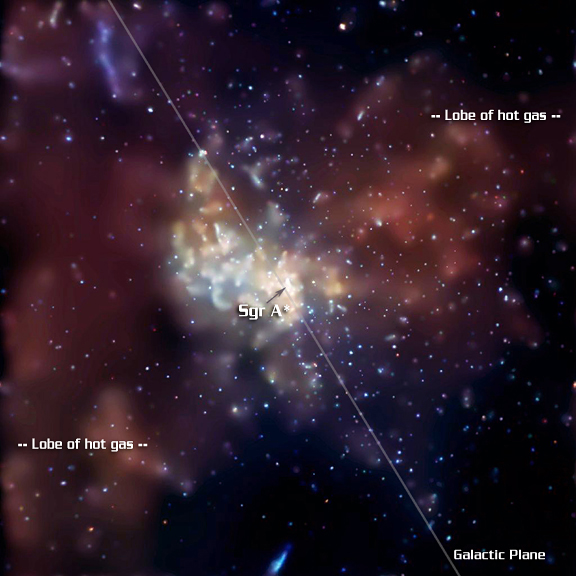
(Image from http://chandra.harvard.edu/photo/2003/0203long/more.html)
You can't actually see the black hole in this, cause well, its black, as no light can escape from a black hole, so what we do see is radiation from material that's heated up as it falls onto the black hole. The radiation's seen as X-rays, because the material's been heated up to about 10, 000, 000K (and you thought it was hotter than Hades in Alabama at the moment!). We can also look at the orbits of stars around the black hole and realize that they're orbiting something really really massive that we can't see and are being torn up, and providing the black hole with dinner (although black holes are more grazers than the three square meals a day type), as they orbit. Its actually pretty cool to look at in a variety of wavelengths, and we're learning more about black holes at the centers of galaxies every day, by studying the one in our back yard.
There's also a whole bunch of cool stuff that you can see with an optical telescope in your backyard, the coolest of which, I think, is the Trifid Nebula, located close to the tip of Sagittarius' arrow:

First of all, the blue gas at the top? Completely unrelated to everything else in that image -- its a chance superposition! Its actually called a reflection nebula, and is basically composed of cosmic dust. When starlight illuminates the nebula from behind, the photons are scattered by the dust. Because different colors of light have different energies, how much each photon is scattered depends on its color. Red photons, because they have less energy, scatter more than blue photons which sort of glance at the dust, wave at it a bit and zip on on their way (this is also why the sky is blue...). So we see the reflection nebula as blue, because all the red photons have been scattered out of our line of sight, while the blue photons make it to us. So that's the first part.
For the second and third parts, we should look at the red bits with black stripes. Enclosed in this packet of gas that's about 7600 light years away and composed of H II (That's basically a whole bunch of protons with some neutrons attached to them... Astronomers call neutral hydrogen H I, and ionized hydrogen, H II.), and has about 30 proto-stars and 120 newborn stars embedded in it (courtesy of the Spitzer Infra-Red Space Telescope). These proto and baby stars are heating the H II gas surrounding them, making it hot and causing it to give off radiation that looks, well, red. The black stripes come from clouds of dust that simply absorb the starlight, much like what we see in the Milky Way, and block the light out. So there you go, the Trifid Nebula.
There's also the Lagoon Nebula, another H II region, located slightly to the SE of the Trifid Nebula:


No comments:
Post a Comment